For years, I accepted development economics as a settled science. Grow GDP, reduce poverty, repeat. The formula seemed simple enough. Then I spent time in communities where the numbers looked good on paper but life felt harder.
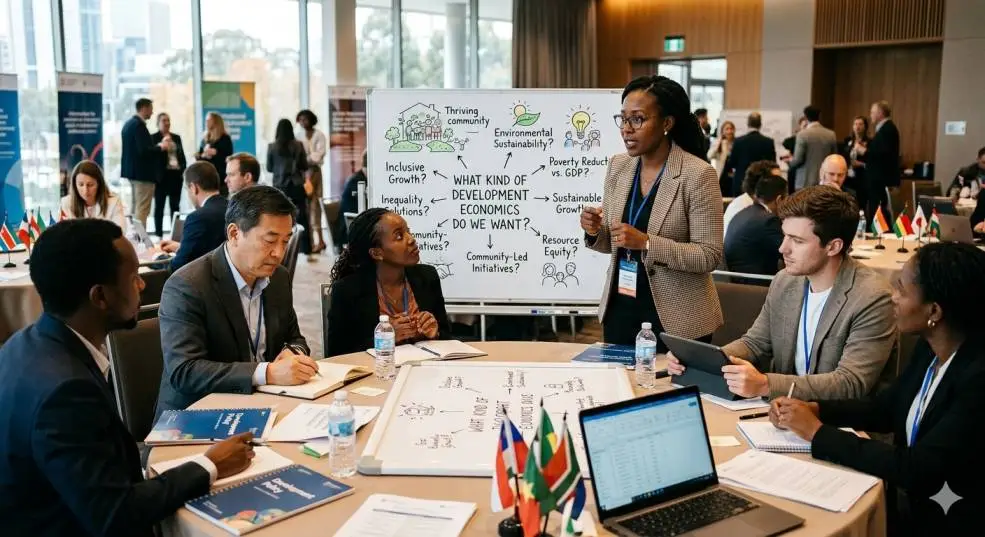
Women working longer hours. Families breathing dirtier air. Farmers watching their soil wash away. The math worked. The people didn't. That is when I started questioning what kind of development economics we want. Not just how to grow. But what to grow. For whom. At whose expense.
This question matters more now than ever. Global institutions are rethinking everything. The old answers are not holding up. If you are trying to make sense of development today, you need honest guidance. No hype. No jargon. Just real talk about what works, what fails, and why we need to choose differently.
Let me share what I have learned.
The Old Model Is Cracking
I used to believe development meant catching up. Poor countries needed to become rich countries. Simple. Then I watched a government cut healthcare funding to pay foreign creditors. The debt was legal.
Read Also: Differences Between Planned and Free Market Economic System
The default was avoided. But children went without vaccines. The numbers stayed balanced. The people did not. This is the crisis hiding inside development economics.
Countries are forced into impossible choices. Repay loans or fund schools. Service debt or build hospitals. Too often, they "default" not on bonds but on people.
The scope of development economics has expanded far beyond what the old textbooks describe. It used to cover investment, trade, industrial policy. Now it must cover climate resilience, unpaid care work, biodiversity loss, and the quiet violence of fiscal compression.
When we start questioning what kind of development economics we want, we are really asking: Should development measure only what markets value? Or should it value what humans need?
The Feb 28 Economic Blackout Protest Showed Something New
Something interesting happened recently. Regular people organized a buying boycott. No politicians. No corporate backing. Just citizens saying enough. The Feb 28 economic blackout protest asked people to stop spending for 24 hours. No Amazon. No Walmart. No gas stations. Only local businesses and essentials.
Why does this matter for development economics? Because it reveals a shift in how people understand power. The group behind it, The People's Union USA, puts it simply: "We control the economy.
This is not traditional protest. This is people recognizing their collective economic weight. The founder, John Schwarz, is not an economist. He is a meditation teacher from Queens who got tired of watching the system trap ordinary people.
The blackout raised over $100,000 for organizing costs. More importantly, it made "economic resistance" a household conversation. When we talk about questioning what kind of development economics we want, movements like this matter. They represent a public demand for economics that serves people, not the other way around.
What Is the Nature of Development Economics Really?
The nature of development economics has always been contested. Some see it as technical problem-solving. Others see it as political struggle.
I land somewhere in the middle. Development economics is the study of how societies improve material conditions. But "improve" is not neutral. Neither is "material." Neither is "conditions."
A 2005 book put it bluntly: the one-size-fits-all approach taken by major players in development resulted in huge waste and disappointments. That was twenty years ago. We have more data now. More models. More experts. Yet the fundamental tension remains.
The nature of development economics involves tradeoffs. Always. Invest in infrastructure or education? Support industry or agriculture? Open markets or protect local producers? These are not technical questions with correct answers. They are value judgments with consequences.
Recognizing this changes everything. It means development is not something done to countries. It is something countries do, with guidance, resources, and yes, constraints.
Why the Importance of Development Economics Keeps Growing?
Some people ask why the importance of development economics matters when we have climate collapse, political instability, and pandemics. The answer is simple: because development choices shape everything else.
Debt distress now crowds out climate investment. Countries cannot build resilience when they are busy repaying creditors. Health systems collapse not because diseases are stronger but because budgets are weaker. Education stalls not because teachers stop caring but because salaries stop coming.
The importance of development economics shows up in who lives and who dies. In which children get vaccinated and which do not. In which farmers adapt to changing rainfall and which watch their fields turn to dust.
When sub-Saharan Africa spends more on debt service than on health, that is a development economics problem. When women's unpaid care work stays invisible in national accounts, that is a development economics problem. When natural capital declines while GDP rises, that is a development economics problem too.
The Scope of Development Economics Keeps Expanding
The scope of development economics used to fit neatly in textbooks. Growth theory. Trade policy. Fiscal management. Project evaluation. Not anymore. Today, the scope of development economics includes:
-
Climate adaptation finance
-
Biodiversity accounting
-
Gender-responsive budgeting
-
Debt sustainability with social safeguards
-
Care economy valuation
-
Natural capital measurement
The World Bank's recent work on "Nature's Frontiers" shows why this matters. Countries can use natural capital more efficiently. Closing efficiency gaps addresses economic productivity, health, food security, and climate change simultaneously. But doing that requires measuring things GDP ignores.
You Must Also Like: Economic Challenges In Developing Countries
This expansion is not academic indulgence. It is survival necessity. The old scope missed too much. It counted trees cut but not forests lost. It valued goods produced but not care provided. It measured market transactions but not ecosystem collapse.
Beyond GDP: A Practical Shift
In January 2026, top economists met at UN Geneva to push for radical change. Their target: GDP. UN Secretary-General António Guterres put it plainly. Global policymaking is over-reliant on GDP data. We witness daily the consequences of failing to balance economic, social, and environmental development.
The "Beyond GDP" initiative argues that GDP places too much value on activities that deplete the planet. Not enough on activities that sustain life and wellbeing.
This is not abstract theorizing. Nobel laureate Joseph Stiglitz and other leading economists are developing actual indicators. A dashboard. Something governments can use.
When we start questioning what kind of development economics we want, this is a concrete answer. We want economics that tracks what matters. Health. Social capital. Environmental quality. Not just market output.
Debt Quality Matters More Than Debt Quantity
One paradigm shift gaining ground involves rethinking debt. Not just how much countries owe. But what kind of debt they hold.
Much of today's debt is short-term. Procyclical. Poorly aligned with long-term investment needs. Private creditors prioritize their interests over public good.
In sub-Saharan Africa, private creditors now hold 57% of external debt. Up from 22% in 2000. This debt is costlier. Harder to restructure. More likely to squeeze public budgets.
What countries need instead is patient, long-term financing. Money that supports productive capacity. Climate resilience. Inclusive growth.
This reframing puts debt quality at the center. Not just whether debt exists. But what it finances. How it is structured. Who holds it. Whether it enables development or extracts resources.
Reforms That Could Change Everything
Several practical reforms could shift development economics toward people and planet.
Debt Pauses During Crises
Climate-resilient debt clauses already exist. They trigger automatic payment suspensions during shocks. The same logic could extend to social crises. Sharp deteriorations in poverty. Health emergencies. Disasters that spike care needs.
Barbados introduced a pandemic debt suspension clause in 2022. The Debt Pause Clause Alliance pushes for broader adoption. This is not charity. It is smart design. Crises should not force countries to choose between paying creditors and saving citizens.
Borrower Coordination
Right now, creditors coordinate through formal clubs. Borrowers mostly negotiate alone. This asymmetry entrenches power imbalances.
Establishing borrower clubs could strengthen collective bargaining. Improve transparency. Share intelligence. Set common thresholds to protect social infrastructure.
When countries coordinate, they reduce the leverage that mobile wealth holds over fiscal policy. They protect the revenue base needed to finance schools, clinics, and care systems.
Updated Debt Sustainability Frameworks
Current frameworks judge countries by their capacity to repay. They overlook critical financing needs for sustainable development.
Reformers want frameworks that distinguish liquidity from solvency. Account for domestic and external debt. Reflect public assets and long-run returns from growth-enhancing investments.
Some proposals even include valuing unpaid care work in national net worth assessments . Tools already exist. ILO guidance. UN Women toolkits. Demographic and Health Survey modules. The data is there. The frameworks just need to use it.
What the Economic Coordination Committee Does?
You might wonder how economic decisions actually get made. The economic coordination committee offers one example.
In Pakistan, the Economic Coordination Committee handles urgent economic matters. It coordinates policies. Recommends reforms. Monitors monetary conditions. Stabilizes prices. Reviews trade policy. Evaluates industrial and agricultural growth.
The economic coordination committee includes finance, investment, commerce, economic affairs, food security, petroleum, power, and planning ministers. It is where high-level tradeoffs happen.
The Philippines has a similar body. Its economic coordination committee ensures consistency across agencies. Directs offices to execute functions quickly. Exercises powers needed for economic reform.
Understanding how these committees work matters for questioning what kind of development economics we want. Decisions do not emerge from abstract forces.
They come from specific people in specific rooms making specific choices. Who sits at those tables. What data they see. Whose interests they prioritize. That is where development economics becomes real.
Success and Failure: Learning from Experience
Academic research on development policies reveals uncomfortable truths. Even when political will exists for developmental policies, economic structures can block them.
Rent-based economies create damaging incentives. Policy externalization via international financial institutions erodes legitimacy and credibility. Both weaken accountability between leaders and citizens.
Comparing Russia and sub-Saharan Africa shows this clearly. Asian developmental states succeeded because they met two conditions: national economic guidance and industrialization. These conditions were met neither in African states nor Russia, though for different reasons.
The lesson: questioning what kind of development economics we want requires looking at actual outcomes. Not just policies adopted. But structures that enabled or prevented success. Not just intentions. But incentives that shaped behavior.
Practical Guidance for Rethinking Development
If you are trying to make sense of development economics today, here is my honest advice.
What to Question
Question what gets counted.
If unpaid care work stays invisible, policy will ignore it. If natural capital decline stays unmeasured, economies will appear healthier than they are.
Question who decides.
Are development strategies imposed by creditors or chosen by citizens? Does the economic coordination committee include diverse voices or just finance ministries?
Question the time horizon.
Short-term budget balance matters less than long-term productive investment. Fiscal space is not fixed. It can expand through investments that enhance social and environmental sustainability.
What to Watch
Watch debt composition.
Not just how much countries owe. But who they owe. On what terms. Financing what.
Watch social infrastructure.
Schools. Health systems. Care for children, older people, those with disabilities. These are not consumption. They are investments with economic and financial returns.
Watch natural capital.
Clean air. Clean water. Fertile soils. Productive fisheries. Dense forests. These are not extras. They are foundations.
What to Avoid
Avoid one-size-fits-all thinking.
What worked in East Asia may not work in Africa. What worked in the 1990s may not work now. Context matters.
Avoid GDP fetishism.
Growth that depletes people and planet is not development. It is liquidation disguised as progress.
Avoid false tradeoffs.
Protecting natural capital does not mean abandoning prosperity. Using resources more efficiently can address economic productivity and environmental goals together.
The Question Keeps Getting Bigger
When I started questioning what kind of development economics we want, I expected answers. Instead, I found better questions.
Do we want economics that extracts or regenerates? That concentrates or distributes? That measures transactions or tracks wellbeing? Do we want development that happens to people or with people? That serves creditors or citizens? That counts what moves or values what matters?
These questions do not have settled answers. They have ongoing struggles. Victories and defeats. Experiments that succeed and fail.
The Feb 28 economic blackout protest shows ordinary people claiming economic power. The Beyond GDP movement shows experts rethinking foundational metrics. Debt reform proposals show institutions acknowledging past failures.
None of this guarantees better outcomes. But it creates possibility. And possibility is where development starts. The kind of development economics we want will not emerge from textbooks.
It will emerge from choices. Hard choices about what we measure, who we prioritize, and how we define progress. Those choices belong to all of us. Not just economists. Not just policymakers. Not just creditors. All of us. That is the point of asking the question. And that is why the question matters.