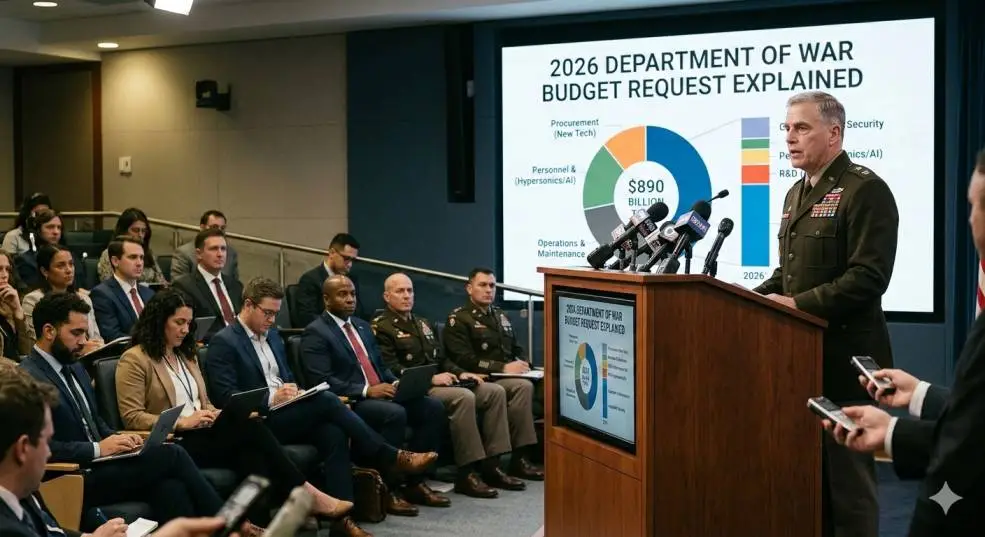
The 2026 Department of War budget request sets the financing arrange for the U.S. military next year. It is portion of the proposition submitted by the United States Office of Defense to Congress.
If you are looking for the U.S. Air Force budget 2026, you likely need straight answers. You need genuine numbers. You need stars and cons. You do not need hype. Let’s break this down in basic terms.
What Is the 2026 Department of War Budget Request?
Each year, the Pentagon submits a subsidizing ask. Congress reviews it. Officials favor, dismiss, or alter parts of it. The ask covers:
-
Military pay and benefits
-
Aircraft and weapons purchases
-
Research and development
-
Daily operations
-
Maintenance and repairs
-
Space and cyber programs
The full details show up in the National Defense Budget Estimates for FY 2026, regularly called the “Green Book.” If you need confirmed information, that record is the most solid source.
Read Also: Face of Defense: Army Instructor Combines Passions as an Elite Mountaineer
How Much Is the U.S. Air Force Budget 2026?
The Air Force budget falls beneath the United States Department of the Air Force. That office incorporates both:
- United States Air Force
- United States Space Force
That things. Space programs presently compete for the same pool of money.
Early projections appear humble development compared to 2025. In any case, expansion diminishes genuine buying control. A little increment may as it were cover higher fuel, labor, and fabric costs.
In basic terms: more dollars does not continuously cruel more capability.
Where the Money Goes in 2026?
Aircraft Procurement. The Air Force continues to replace aging aircraft. Major programs include:
-
F-35 Lightning II (Air Force variant)
-
B-21 Raider
-
KC-46 Pegasus
-
Next Generation Air Dominance (NGAD)
I have surveyed a few past budget cycles. One design remains steady. The Air Force buys less air ship than in the 1980s or 1990s, but each air ship costs distant more.
That appears a clear move. The methodology favors progressed frameworks over armada estimate.
Pros
-
Better survivability
-
Stronger deterrence
-
Advanced sensors and stealth
Cons
-
Smaller overall fleet
-
High maintenance costs
-
Fewer backup options in long wars
If production slows or costs rise, force size could shrink further.
Research and Development
R&D remains a priority in the 2026 Department of War budget request. Key focus areas include:
-
Hypersonic weapons
-
Cyber defense
-
Space systems
-
Advanced propulsion
-
Autonomous aircraft
R&D spending helps the U.S. stay ahead of competitors like China and Russia. However, research does not always produce quick results. Some projects take years. Others fail.
You Must Also Like: Which 7 military branches are there?
Strong oversight is critical here.
Space Programs
The Space Force continues to grow inside the Department of the Air Force. Funding supports:
-
Missile warning satellites
-
Secure communication systems
-
GPS modernization
-
Launch services
Modern warfare depends on space assets. Without satellites, navigation, targeting, and communications suffer. At the same time, satellites are vulnerable.
Anti-satellite weapons are advancing. That creates a new risk area the budget must address.
Operations and Maintenance
This category often gets ignored. It should not. It pays for:
-
Pilot training hours
-
Base operations
-
Equipment repairs
-
Fuel
-
Spare parts
When budgets tighten, training hours are often reduced first. That affects readiness. I have seen past budgets cut flight hours to control costs. That weakens skill retention.
Modern aircraft mean little if pilots do not train enough.
Military Budget 2026 by Country: Where the U.S. Stands
The United States still spends more on defense than any other country. China continues to expand rapidly. Russia focuses on missile systems and regional strength. The U.S. spreads its budget globally.
It funds overseas bases, alliances, and forward deployments. That global presence increases costs but also expands influence. Comparing total numbers alone can mislead readers. Spending structure matters more than raw size.
Honest Pros and Cons of the U.S. Air Force Budget 2026
Strengths
-
Strong modernization focus
-
Continued bomber development
-
Protected research funding
-
Space capability expansion
Weaknesses
-
Aging aircraft still in service
-
Limited procurement quantities
-
Rising unit costs
-
Maintenance backlog risks
The Air Force tries to balance today’s readiness with tomorrow’s threats. That balance remains difficult.
Common Questions About the 2026 Department of War Budget Request
Is the Air Force budget increasing?
Yes, slightly. But inflation reduces real growth.
Why retire aircraft during expansion?
Older aircraft cost more to maintain. Retiring them frees money for newer systems. Still, retirements reduce total fleet numbers.
Does higher spending guarantee superiority?
No. Training, logistics, strategy, and leadership matter as much as funding. History shows that efficient forces often outperform larger ones.
Practical Advice for Reading the Green Book
If you want trustworthy information, follow these steps:
-
Check procurement quantities, not just dollar totals.
-
Adjust numbers for inflation.
-
Compare requested amounts with final approved funding.
-
Watch multi-year program trends, not one-year spikes.
The National Defense Budget Estimates for FY 2026 Green Book provides historical tables. Those tables reveal long-term patterns.
Headlines often miss those trends.
Risks to Watch in 2026
Every budget carries trade-offs.
If funding drops:
-
Training may decrease
-
Modernization may slow
-
Readiness may fall
If funding rises without reform:
-
Costs may balloon
-
Delays may increase
-
Oversight gaps may grow
Smart budgeting requires discipline and accountability.
What This Means for the Future?
The 2026 Department of War budget request clearly prioritizes:
-
Advanced aircraft
-
Space superiority
-
High-end conflict readiness
-
Deterrence against major powers
It does not prioritize expanding force size rapidly. The strategy favors quality over quantity. That approach works well in short, high-tech conflicts. It may create strain in long, large-scale wars.
Who This Budget Strategy Fits Best?
Best suited for:
-
Peer competition
-
Precision strike missions
-
Technology-driven operations
Less suited for:
-
Sustained mass conflict
-
Rapid force expansion
-
Low-cost, high-volume warfare
Understanding that distinction helps you interpret the numbers correctly.
Final Thoughts
The 2026 Department of War budget request shows steady modernization. It supports advanced aircraft like the B-21 and next-generation fighters. It strengthens space systems. It maintains research funding.
At the same time, it limits fleet growth. Costs remain high. Execution risks persist. If you are evaluating the U.S. Air Force budget 2026, focus on structure, readiness, and long-term trends.
- Ignore dramatic headlines.
- Follow the data.
- That is where the real story sits.