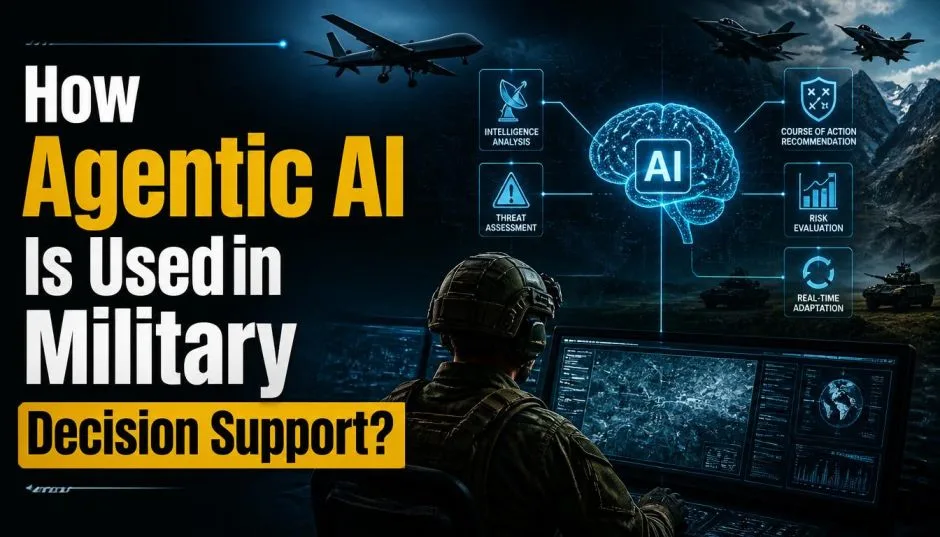
The concept sounds like science fiction, but it's happening now. Militaries aren't just using AI for data analysis. They're deploying agentic AI systems.
These are digital entities that perceive, reason, and act to achieve specific goals with minimal human input. These systems are moving beyond simple recommendations to become active participants in decision-making. They act like intelligent staff officers assisting commanders in high-pressure situations.
Here's a real-world, experience-based look at how agentic AI is used in military decision support. I'll cover what it can do, what it cannot do, and the critical risks you need to understand.
What Exactly Is Agentic AI in Military Contexts?
Agentic AI is different from standard AI tools. Standard AI answers questions when asked. Agentic AI takes initiative. Think of it as a digital staff officer. It monitors the battlefield.
Read Also: Future Military Weapons and Defense Systems 2025
It identifies problems before humans notice them. It proposes solutions without being prompted.
During a recent military exercise at Eglin Air Force Base, the AlphaMosaic system demonstrated this clearly. Weapon systems officers were overwhelmed with incoming data from multiple sensors.
The AI processed all that information instantly. It generated three tactical options within seconds. Officers then chose the best one. That's the core difference. Agentic AI doesn't wait for instructions. It actively works alongside human operators.
How Does Agentic AI Support Military Decision-Making?
The military decision-making process traditionally takes time. Intelligence arrives. Analysts interpret it. Commanders meet. Plans are drafted. Orders are issued. In modern warfare, that timeline doesn't work anymore.
Agentic AI compresses this timeline dramatically.
The Air Force's DASH experiment showed impressive results. Command staff using AI tools made decisions seven times faster than those working manually. They could address twice as many problems. Their solutions were three times more numerous and varied.
That's not theory. That's measured performance from actual military tests.
Processing Information at Machine Speed
Modern battlefields generate massive data flows. Drones send video feeds. Satellites transmit imagery. Ground sensors report movements. Radars track aerial threats.
A human brain cannot process all this simultaneously. Agentic AI can.
The AI filters incoming data. It identifies patterns. It flags anomalies. It prioritizes threats. By the time a human commander looks at the screen, the AI has already done the heavy lifting.
Generating Actionable Options
Information processing is just the first step. Agentic AI goes further by generating specific recommendations.
For example, when an air defense threat appears, the AI might suggest three responses. Option one: evasive maneuvers to ensure survivability. Option two: maximum speed to reach the target faster. Option three: accepting higher risk for maximum lethality.
The commander evaluates these options and makes the final call. The AI saves them from starting from scratch.
Adapting to Dynamic Conditions
Battlefields change constantly. Enemy units move. Weather shifts. Supplies run low.
You Must Also Like: Air Force Eyes New Hypersonic Missile Following ARRW Tests
Agentic AI adapts to these changes in real-time. It doesn't follow fixed scripts. It recalculates as conditions evolve.
During the AlphaMosaic tests, agents called for aircraft refueling after using only 20% of their fuel. That seemed premature to observers. But the AI was anticipating future engagements. It was planning several moves ahead, like a chess master.
The Architecture Behind Agentic Military AI
Understanding how these systems work helps you assess their strengths and weaknesses.
Specialized Agents, Not a Single System
Agentic military AI isn't one giant program. It's a network of specialized agents. Each agent handles a specific task.
One agent manages fuel logistics. Another handles weapon assignment. A third coordinates flight positions. These agents communicate within a larger ecosystem.
This design offers practical advantages. If one agent fails, others keep working. You can update individual agents without overhauling the entire system.
Spatial Intelligence and Geo-Commander
One major challenge for AI is understanding physical space. Traditional AI struggles with dynamic spatial tasks. Selecting the best position for a tank unit on a battlefield requires more than abstract reasoning.
Researchers developed Geo-Commander to solve this. This framework combines spatial encoding with reasoning mechanisms. Instead of just thinking about the battlefield, the AI can visualize terrain.
Geo-Commander uses hexagonal grid encoding to screen locations. It integrates geographic insights into its decision-making loop. In tank combat simulations, it significantly outperformed standard AI models. It achieved better selection quality, higher win rates, and greater overall combat effectiveness.
The Intelligent Staff Officer Concept
Agentic AI is evolving from a tactical tool to a strategic partner.
The ODIN system, developed in Ukraine, exemplifies this evolution. ODIN fuses multiple intelligence sources. It prioritizes threats. It generates multi-domain action plans covering kinetic, non-kinetic, and cyber operations.
But ODIN's most valuable feature is playing "devil's advocate." It deconstructs existing staff plans. It identifies hidden assumptions. It spots logical gaps and weak points.
This "AI questions, human decides" model forces commanders to think more critically. The AI challenges them. It doesn't just offer solutions. It tests their thinking.
Real-World Applications and Tests
Agentic AI isn't just theoretical. It's being tested in operational environments.
AlphaMosaic at Eglin Air Force Base
Leidos developed AlphaMosaic for the U.S. Air Force. During 2025 exercises, it helped weapon systems officers make complex decisions in seconds. Officers using the system requested additional targets because the AI freed their mental capacity for strategic thinking.
The system's modular design allows continuous upgrades. Military coders and industry developers can update specific agents without disrupting the entire network.
ODIN in Ukraine
Ukrainian forces have deployed ODIN in operational settings. The system integrates intelligence from multiple sources. It generates action plans for combined operations.
Observers noted ODIN's ability to challenge staff assumptions. This "devil's advocate" function prevents groupthink. It exposes flawed reasoning before decisions are finalized.
Transformational Model and C2 Integration
The U.S. Air Force is developing the Transformational Model for command and control integration. This initiative aims to "decompose" complex battlefield situations into actionable entities. The system proposes specific actions—from striking hostile forces to resupplying friendly units.
The goal is continuous improvement. Both military and industry coders can upgrade the system over time.
The Critical Risks You Need to Know
Agentic AI offers powerful capabilities, but the risks are serious. Military experts and ethicists have raised major concerns.
The Black Box Problem
Many AI systems are opaque. Commanders cannot always understand why an AI made a particular recommendation.
This is unacceptable when lives are on the line. Without explainability, trusting the system becomes a gamble. You're essentially betting your troops' safety on a black box.
Bias and Hallucinations
AI systems reflect their training data. If that data is biased, the AI's recommendations will be biased too.
The International Committee of the Red Cross has warned about this. Deficient training data can cause AI to single out ethnic groups. It can misclassify civilians as combatants.
Hallucinations are another concern. AI sometimes invents patterns that don't exist. In a targeting scenario, the AI could misclassify a school bus as a military objective if enemy combatants once used a similar vehicle.
Automation Bias
Humans tend to trust machines, especially under pressure. If an AI system is fast and confident, human operators might skip verifying its outputs.
This is called automation bias. When decisions must be made in seconds, people may rubber-stamp AI recommendations. That leads to catastrophic errors.
Accountability and the Law
Who is responsible if an AI-supported decision causes civilian casualties? The system can't be held accountable. The human commander can.
But if the AI's reasoning is opaque, establishing accountability becomes nearly impossible. International Humanitarian Law requires adherence to principles like distinction and proportionality. An AI cannot make these moral judgments. It can only process data.
The final decision must always rest with a human.
Final Thoughts
Agentic AI is already reshaping military decision-making. It speeds up planning. It generates novel options. It reduces cognitive load on commanders.
But it is not a silver bullet.
The technology is powerful. The stakes are too high for blind trust. Human commanders must stay firmly in the driver's seat.
Ask hard questions. Verify capabilities. Demand explainability.
And never forget that decisions affecting human lives require human judgment, no matter how advanced the algorithm.