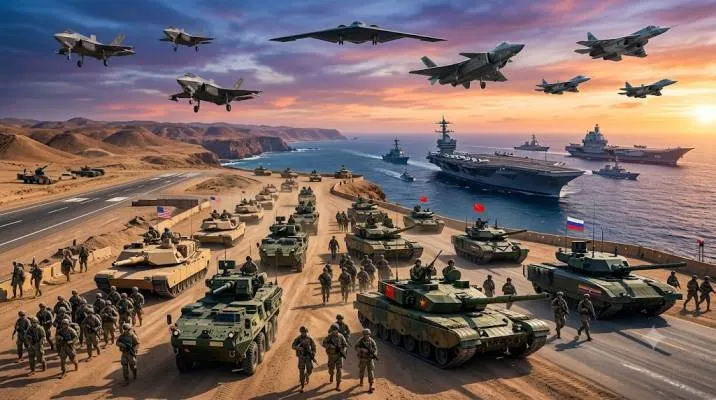
The United States still holds the title for the strongest military in the world in 2026. Global Firepower’s latest ranking puts America at number one with a Power Index score of 0.0741.
Russia sits second, China third. But numbers never tell the whole story. I have followed military rankings for years, and I learned one thing fast: a score on a spreadsheet does not win wars.
The strongest military force in the world depends on what you measure. Budgets? Troop counts? Combat experience? Each answer changes the list. Here is an honest look at the biggest military forces in the world, what the rankings actually mean, and where they fall short.
What the Global Firepower Ranking Actually Measures?
Global Firepower releases a yearly index. It looks at 145 countries. The score uses more than 60 factors. These include money, geography, logistics, manpower, and equipment.
Read Also: Guide to United States Air Force Basic Military Training
The Power Index works backward. A lower score means a stronger military. A perfect score would be 0.0000. No country reaches that. The United States scored 0.0741 this year. Russia scored 0.0791. China scored 0.0919.
That gap between one and two looks small. It is not. The difference between a 0.07 and a 0.08 is massive when you crunch the variables.
Global Firepower does not count nuclear weapons in the main index. That is a huge omission. A country with 5,000 nukes and a weak navy can still erase a city. The ranking ignores that reality. It focuses on conventional fighting power.
The index also does not measure alliances. NATO combines 32 militaries. That collective force is not on the list. So when someone asks “who has the strongest military,” the answer depends on whether you mean one country or one team.
The United States: Why It Still Sits at Number One?
The U.S. military dominates in three areas. Air power. Naval power. Global reach.
America operates 11 aircraft carriers . No other nation comes close. China has three. Russia has one that spends more time in repair than at sea. A carrier group projects power across oceans. It can launch strikes from anywhere. That capability alone keeps the U.S. on top.
The defense budget tells the same story. The United States spent $975.6 billion in 2026. China spent $351.7 billion. Russia spent $166.1 billion. America outspends the next two countries combined.
That money buys stealth fighters. It buys satellites. It buys a network of bases in Europe, Asia, and the Middle East. No other military can move troops and supplies across the globe like the U.S. can.
The Weakness: America’s force is stretched. It has commitments in Europe, the Middle East, and Asia. The active-duty force is around 1.3 million. That is smaller than China’s 2 million. The U.S. relies on technology to make up for smaller numbers. That works until the technology fails or gets jammed.
Russia: Second Place Despite the War in Ukraine
Russia holds the number two spot. That surprises some people. The war in Ukraine has cost Russia heavily. It lost tanks, troops, and equipment at a staggering rate. But the Global Firepower index still ranks Russia second. Why?
You Must Also Like: Comprehensive Defense Strategy for Border Protection
Russia has the most tanks in the world. It has massive artillery stocks. It has a deep reserve of manpower. It also has a large nuclear arsenal, even if the index does not count it directly.
The ranking looks at raw numbers. Russia has more tanks than anyone. It has more artillery pieces. It has more surface-to-air missile systems. Those numbers matter in a ground war.
The Reality Check: Numbers do not tell the full story. Sanctions hurt Russia’s ability to replace advanced parts. Its navy is weak. Its air force has struggled to gain control of Ukrainian skies.
The second-place ranking reflects stockpiles, not performance in the field.
Analysts point out that Russia’s losses in Ukraine have exposed gaps in logistics and command. The index does not capture those failures. It counts what a country owns, not how well it uses it.
China: Third Place but Growing Fast
China ranks third with a score of 0.0919 . It has the largest active-duty military in the world: over 2 million personnel.
China’s navy is expanding faster than any other. It now has more ships than the U.S. Navy, though many are smaller. It is building aircraft carriers. It is developing hypersonic missiles. It is investing in space and cyber capabilities.
The ranking places China third. But the gap between China and Russia is small. And the gap between China and the U.S. is closing in some areas.
The Question Mark: China has not fought a major war in decades. Its last significant conflict was in 1979 against Vietnam. The index cannot measure combat experience. It cannot measure how a military performs under the stress of real combat.
Analysts note that China’s operational uncertainties remain, especially in high-altitude warfare and real combat exposure. The ranking gives China third place. But it does not answer whether China’s military would perform as well as its equipment suggests.
The Biggest Military Does Not Always Mean the Strongest
This is the trap most people fall into. They see a country with millions of soldiers and assume it is the strongest. China has 2.04 million active troops. It ranks third. India has 1.48 million. It ranks fourth. North Korea has 1.28 million. It ranks 31st.
Why is North Korea so low? Because troop count means nothing without equipment, logistics, and training. North Korea has a nuclear arsenal and chemical weapons. But its conventional forces are outdated. Its air force flies 1960s-era jets. Its navy is barely functional.
India ranks fourth. It has a balanced force. It has manpower, missiles, and a growing navy . But it faces challenges with indigenous manufacturing and joint operations.
South Korea ranks fifth. It has a smaller budget than France or Germany. But it has high readiness and advanced technology . It faces a constant threat from the North. That threat keeps its military sharp.
The Real-Time Ranking Shift: France, Japan, and the UK
The top five stayed the same from 2025 to 2026. But the middle of the top ten shifted.
France moved to sixth place. It climbed from seventh. France has nuclear weapons, global bases, and advanced aerospace technology. It is Europe’s most expedition-ready military.
Japan moved to seventh. It climbed from eighth. Japan is slowly shifting away from its post-war constraints. It is building a more assertive defense posture.
The United Kingdom slipped to eighth. It was sixth two years ago. The UK faces shrinking force size and budget pressure. It still has nuclear submarines and elite special forces. But its overall conventional capability is declining.
Turkey held ninth. Italy held tenth. Brazil rounded out the top ten in some versions of the ranking.
Where the Ranking Gets It Wrong?
Global Firepower is a useful tool. But it has blind spots. I have learned to read it with caution.
Blind Spot 1: Nuclear Weapons
The index does not count nuclear weapons directly. That means a country with a massive nuclear arsenal gets no credit for it. North Korea has nukes. It ranks 31st.
Israel has nukes. It does not crack the top ten. The ranking measures conventional war. But nuclear weapons deter conventional war. That paradox is ignored.
Blind Spot 2: Alliances
NATO is not on the list. If it were, it would rank first by a wide margin. The combined defense spending of NATO members is over $1 trillion. The combined military might includes American carriers, French jets, German tanks, and Turkish drones. No single country can match that.
Blind Spot 3: Combat Experience
The index cannot measure how a military performs in actual war. Russia ranks second. But its performance in Ukraine has been uneven. The U.S. has not fought a peer competitor since World War II. How would it perform against China? Nobody knows.
Blind Spot 4: Cyber and Space
The index includes some cyber factors. But it does not fully measure space capabilities. The U.S. Space Force, China’s space program, and Russia’s anti-satellite weapons are not fully captured. A war in space could blind a military in minutes. The ranking does not reflect that.
What Actually Makes a Military Strong?
After years of watching these rankings, I have formed my own view. Hardware matters. But it is not everything.
1. Logistics
You can have the best tanks. But if you cannot fuel them, they are scrap metal. The U.S. excels at logistics. It can move supplies across the globe. Russia struggles with logistics in its own backyard.
2. Training
A soldier with a rifle who trains daily beats a soldier with a rifle who trains monthly. Training creates muscle memory. It creates discipline. It creates units that do not panic under fire.
3. Command and Control
A military needs clear orders and fast communication. Russia’s command structure in Ukraine has been criticized. The U.S. has a decentralized command system. That allows units to adapt.
4. Morale
A military fighting for its survival fights harder than one fighting for a paycheck. Ukraine’s performance against Russia shows this. Ukraine ranks 20th in the index. But it has held off a much larger force for years.
FAQ's- About Biggest Military Forces In the World
Who has the strongest military in 2026?
The United States. It ranks first in Global Firepower with a score of 0.0741.
What is the biggest military force in the world?
China has the largest active-duty force with over 2 million personnel. But size does not equal strength.
Is Russia’s military stronger than China’s?
Global Firepower ranks Russia second and China third. But the gap is small.
Where does India rank?
India ranks fourth. It has a balanced force and growing capabilities.
Does the ranking count nuclear weapons?
No. The main Global Firepower index does not directly include nuclear arsenals.
The Final Thoughts
Global Firepower gives us a way to compare militaries. It is a useful starting point. But it is not the final word.
The United States holds the top spot. It has the budget, the technology, and the global reach. Russia sits second on paper. But its war in Ukraine has exposed weaknesses. China sits third. But it lacks recent combat experience.
The strongest military force in the world is not just a number. It is a combination of equipment, training, logistics, leadership, and will. The ranking cannot measure all of those things.
Use the ranking as a guide. But do not treat it as gospel. The real answer to “who has the strongest military” depends on what you are measuring. And no spreadsheet can predict the outcome of a real war.